

Spotlight on Organic Peruvian Ceremonial Cacao
Dear Somastars, The days are getting warmer, and life is hotting up at Soma. All five of our cacao origins are fully stocked - it feels like having all our children home for Christmas....

When I arrived back in Australia after three years living in Mexico and began my search for cacao, I had no idea that there was a ‘ceremonial’ cacao movement worldwide, nor did I realise there were debates surrounding its use. To me and my friends living in Mexico, it was simply ‘cacao’.
We enjoyed it as a meditation-friendly coffee replacement, as a key ingredient in raw vegan treats, as a bonding experience during meetings, and as a heart-opening tool before special events. For us, the subtle magic of this plant medicine was a light, joyful and playful energy that infiltrated our days and brought us closer together.
We were yogis, not shamans: more interested in revealing our inner essence, found in moments of profound silence, than in the shamanic control of the natural world implied by the term “ceremonial cacao”.
Cacao is everywhere in Mexico. The beans can be found in local grocery stores, even in the tiny fisherman’s village on the Pacific coast where we lived.
I loved going to Oaxaca City and visiting the colourful shops dedicated entirely to cacao, where you can buy kilos of cacao paste, sometimes ground up for you right there on the spot. In San Cristobal de las Casas, Chiapas, cacao ‘cafes’ are as plentiful as coffee shops.
As my partner Alistair will attest, this is my idea of heaven!
When I learned about the controversies surrounding ’ceremonial’ cacao, my happy vision of sharing it with others back home in Australia was tainted by concerns of cultural appropriation.
But the more I’ve delved into this, the more I uncover contradictions and historical misconceptions, which I’ve tried to outline on this page as best I can.
Basically, the deeper I dig with the keen eyes of a post-graduate history student drilled in the art of scrutinising unsubstantiated claims, the more my fears are allayed, and so I feel comfortable about my love affair with cacao and desire to share it it on my own unique way.
Whether you attend events that include cacao as an exploratory tool, or just drink it at home for a happy, healthy buzz, being equipped with a critical understanding of the history of cacao may come in handy – especially if you ever get caught up in a cultural appropriation discussion.
And, even more importantly, confronting these issues invites careful reflection about the intention behind our choice to share and/or consume cacao.
And this isn’t to say there is a ‘correct’ intention.
It is just to suggest that it is always helpful to be aware of what it is that we are doing, and why.
Perhaps then we’re more likely to act with authenticity and integrity.
Are we trying take on the ancient religious practices of an Indigenous minority on the other side of the world?!
If this is really what we’re trying to do, we could ask ourselves… why would we do this?
Or…
Are we simply embracing an incredibly healthy food gifted to us by nature: for the taste, health benefits, and the way it makes us feel – supporting us on our own personal journey or path, whatever that might be?
Again, there’s no right or wrong answer here.
It’s just an invitation to tap into what feels true for you.
Earnestly.
There are two main points of contention regarding the use of cacao, which I will address in turn:
• The term "ceremonial-grade", and
• The recent rise in popularity of cacao ceremonies
Cacao (prounounced ka-kow) generally refers to the fruits and seeds (which we call beans) of the theobroma cacao tree, a small evergreen native to tropical America.
The word cacao is derived from Olmec and the subsequent Mayan languages (kakaw); the chocolate-related term cacahuatl is Nahuatl (Aztec language), derived from Olmec/Mayan etymology.
Theobroma comes from the Greek words ‘theos’, meaning '“god”, and ‘broma’, meaning “food” therefore theobroma cacao literally means the “food of the gods”.
In their raw state, cacao seeds are very bitter, and unsuitable for human consumption.
Somehow, ancient civilisations discovered that the process of drying, fermenting and roasting the seeds mellows out the flavours.
One theory holds that the Olmecs may have eaten the cacao fruit, spat out the seeds into the fire, and the rich smell of them roasting inspired them to think “maybe there’s something more we could do with this”.
In Aztec and Mayan legend, cacao was discovered by the gods in a mountain containing other delectable foods (like maize, a.k.a. corn – considered even more sacred than our beloved cacao).
The god ‘Sovereign Plumed Serpent’ gave cacao to the Maya after humans were created from maize by the divine grandmother goddess Xmucane.
So-called “ceremonial-grade” cacao generally refers to Meso-American beans that have been fermented, lightly roasted, and ground into a paste.
“Ceremonial-grade” cacao, we are told, must be minimally processed, organically grown, and harvested in small-batches using traditional methods.
Some sources suggest it needs to be grown and distributed with the sole intention of ceremonial use.
FOOD FOR THOUGHT:
has cacao historically ever been grown with the sole intention of ceremonial use?
Others say it is essential that ceremonial-grade cacao has been personally blessed by a Mayan elder, or some form of Indigenous priestess.
One modern-day American ‘cacao shaman’ insists on checking each and every bean before it is ground up into cacao paste, and personally blessing each block before it is sent across the world.
Cacao with these additional spiritual ingredients (for lack of a better descriptor) carries a hefty price tag.
FOOD FOR THOUGHT:
If, in accordance with Mayan and Aztec legend, cacao is intrinsically spiritual, why does it need all these additional man-made blessings?
I keep stumbling upon more and more products describing themselves as ‘ceremonial-grade’ that hardly meet any of these criteria.
I’ve found ‘ceremonial-grade’ cacao powder, I’ve seen the term describing cacao that has been mass-produced and exported in bulk, and with cacao grown far from its Meso-American origins – for example in Trinidad, Sri Lanka, and Tanzania.
There is no central authority determining what does and does not constitute ceremonial-grade cacao.
The rules appear to be being made up as we go along, largely by those who are already selling ‘ceremonial-grade’ cacao.
The type of bean also allegedly plays a role in determining whether cacao is worthy of the ‘ceremonial-grade’ label.
Generally, cacao is classified into three main categories:
criollo
forestero
trinitario
We are told that criollo cacao is delicate, with an incredible flavour profile, and that it constitutes less than 1% of all cacao harvested in the world.
This is usually the variety described as ‘ceremonial-grade’, though trinitario is also often deemed appropriate for ‘ceremonial’ use, due to its very similar chemical composition.
Forastero is what 90% of the market is made of, and originated in South America.
This is sometimes described as the ‘cheap and nasty stuff’ used in Africa by big manufacturers because it is disease resistant, so they say.
Trinitario is the happy medium – some of the hardiness of forastero with the rarity, and rich flavour profile of criollo.
Trinitario beans are a natural hybrid that first occurred when forastero seeds were introduced to Trinidad after a hurricane all but destroyed their criollo trees, and the two species cross-pollinated.
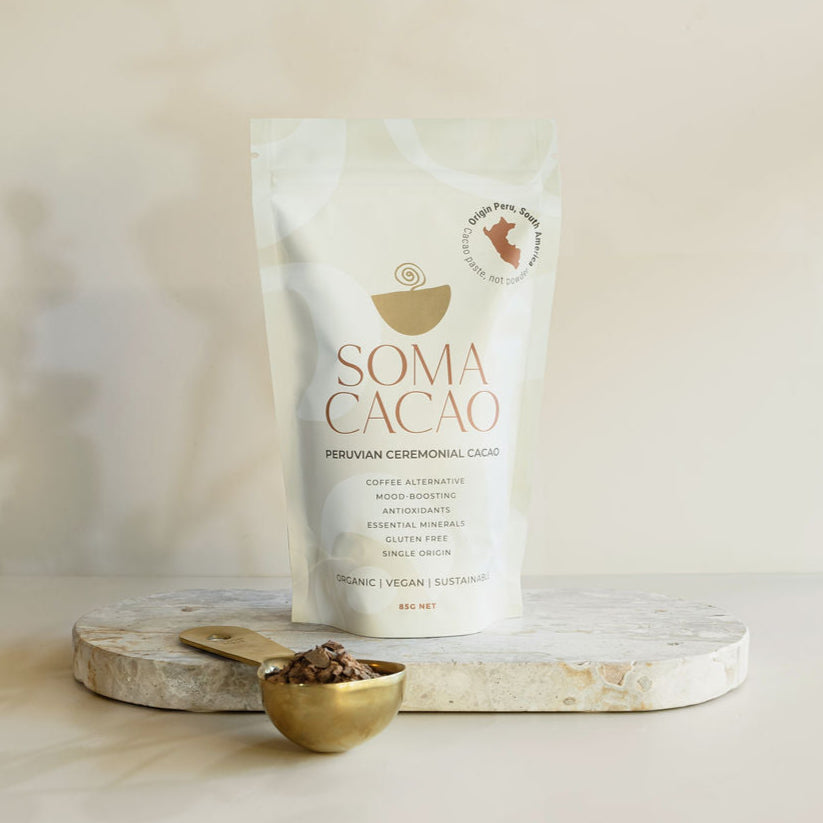
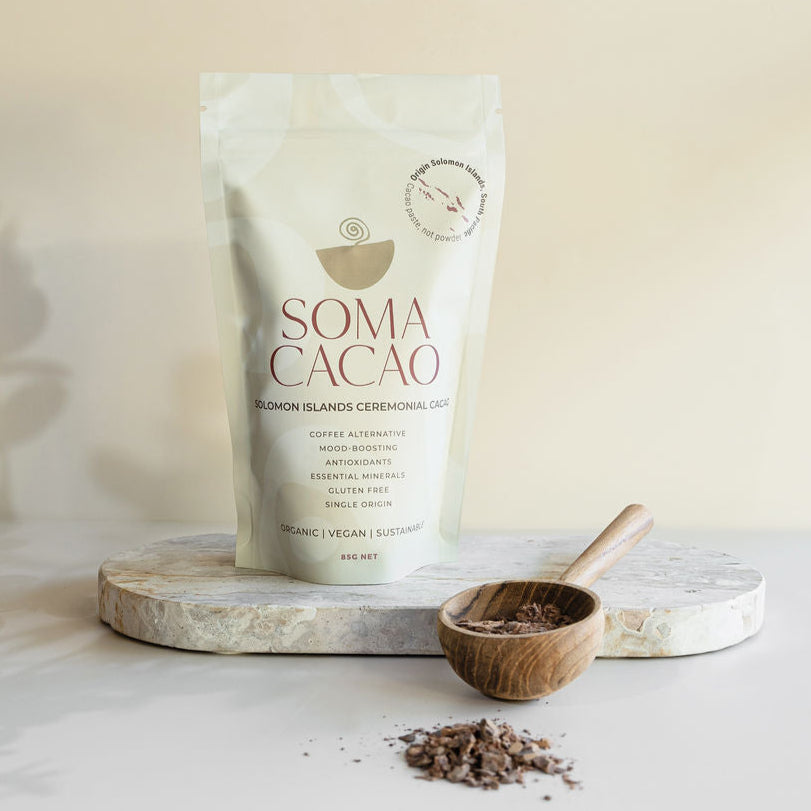
Our Mexican and Peruvian cacaos is considered to be made from criollo beans (though the Mexican species is technically called "almendra blanca" and our Daintree, Karkar Island, and Solomon Islands cacaos all consist of predominantly trinitario beans.
BUT.
While it’s true that some tribes who work with cacao are very particular about the type of bean they use, there are other Indigenous groups in Central and South America who are happily using forastero cacao to accompany their rituals – by virtue of the fact its grown on their land.
For them, the type of bean is of no real significance.
Cacao is cacao.
So how did we get so fussy about the species of bean in the West?!
Also, according to Steve Bergin, an environmentalist and renowned cacao expert from Conservation Cacao:
“classifying cacao as Criollo/Forastero/Trinitario was one of the great foundational linguistic screw-ups in the history of the New World”.
This is because:
a) ‘Criollo’ simply means ‘someone or something originally from some place’ whereas ‘forastero’ means ‘from somewhere else’.
b) There are more than ten major families of cacao, and this simplistic trifecta ignores the complex genetic diversity within the species.
c) The characteristics associated with criollo/forastero/trinatario beans are sometimes totally out of whack.
d) At present, the only cacao that even resembles the pure variety that the Maya would have used can be found as individual trees in the wild in Mexico, Guatemala and Belize. According to Conservation Cacao, none of this cacao is available for consumption.
e) Scholars have shown that the wild ancestors of Mexican cacao are genetically different from current criollo bean plantations, even in the same region, and also totally different to, for example, Peruvian wild cacao plants.
FOOD FOR THOUGHT:
So what we now call 'criollo' beans originated in Central America, and 'forastero' beans are native to South America.
Who deemed Central American beans more 'ceremonial' than South American?
Or is it simply a matter of to which 'expert' we speak?
So we’ve established that the use of the term ‘ceremonial-grade’ is pretty inconsistent.
To say the least.
We’ll now turn to the other half of the great debate: the use of cacao in ceremonies.
These days, a ‘cacao ceremony’ is a broad concept referring to an activity involving cacao combined with intention-setting, personal-development, creative expression, and/or spiritual exploration.
It can be formal or informal, performed alone or in group, in silence or with music, and at any time of day.
They are becoming popular worldwide, especially in North America and Europe, and increasingly so down here in Oz.
Those with no Indigenous Meso-American blood running through their veins risk scrutiny when they hold events featuring cacao.
This is cultural appropriation, some say.
But this is tricky territory, because unlike other plant medicines that have a long lineage of ceremonial-use, cacao ceremonies appear to be a new phenomenon.
There are no references to the facilitation of cacao-centred spiritual journeys in any indigenous cultures throughout history.
The notion of a shaman dedicated exclusively to cacao is a modern construct.
But let’s backtrack a little…
Cacao has certainly been a sacred part of Meso-American cultures for millennia.
But its use was extensive, not exclusively for rituals.
According to many historians and archaeologists, the production, acquisition, and circulation of cacao was grounded in social relations, and also, at least in Mayan civilisations, cacao became readily available to almost everyone. In many Mayan households, cacao was enjoyed with every meal, as a thick and frothy drink combined with chili peppers and water.
Indigenous peoples of the New World passed on the knowledge of cacao through oral histories, stonework, pottery and the creation of codices (intricate documents) that extolled cacao and documented its use in everyday life and ritual.
This archaeological evidence demonstrates cacao was a staple in ritual feasts, and served as an offering during important ceremonies like funerals and marriages.
The notorious Mexican ruler, Montezuma II, allegedly gave it to his warriors prior to battle, and drank cacao as an aphrodisiac before visiting any one of his many wives.
In an account by the Spaniard Díaz del Castillo in 1560:
“From time to time they brought him, in cups of pure gold, a drink made from the cocoa plant, which they said he drank before he visited his wives. At first we did not take much notice of this, but I saw that they brought him more than fifty large jars of good cacao, all foaming, of which he drank...
When the great Montezuma had eaten, all his guards and many more of his household servants ate in their turn. I believe that more than a thousand dishes of food were served, and more than two thousand jars of cacao, frothed in the Mexican way.”
It was evidently also exchanged as a currency, like gold.
López-Gómara described the marketplace at Tlatelolco and commented on the goods for sale:
“The most important of all [goods in the marketplace], which is used for money, is one that resembles the almond, which they call cacahuatl, and we cacao”.
Cacao has also been utilised extensively for its medicinal properties.
The ‘Florentine Codex’ suggested a remedy made out of cacao beans, maize and herbs to treat fever, shortness of breath and heart conditions.
European and New Spain manuscripts from the 16th to early 20th century reveal more than 100 medicinal uses for cocoa or chocolate.
After the Spanish encountered cacao in Mexico, they introduced it to their court in 1544. Within a century, cacao had spread throughout Europe. At first, the Church banned cacao due to its euphoric effects. Cacao plantations were later established in the Caribbean and throughout colonial territories.
The Mayan word cacao entered scientific nomenclature in 1753 when Linnaeus coined the genus Theobroma cacao.
After the 1880s, cacao was fully embedded as the chocolate we know today, with commercial production expanding throughout West Africa.
Cacao is still used as an offering during some Mayan rituals in Chiapas and Guatemala.
These rituals do not resemble modern Western cacao ceremonies.
There is no hard evidence to suggest cacao-centric ceremonies were ever held historically, with one exception: the Mayan annual festival for Ek Chuah, the patron saint of cacao growers (an event which also included the sacrifice of a dog and other animals, ritual blood offerings, incense, and grotesquely adorned figures decorated with paint made from cacao.)
First, it is worth noting that like yoga, coffee and wine, globalisation has gifted us cacao.
Pure cacao is a healthier and more ethical way to experience chocolate, and acts as a counter-movement to the controversial ‘Big Chocolate’ industry.
At the same time, cacao has evidently played a very important role throughout the history of Meso-American civilisations. We believe it deserves respect, discernment and humility.
This belief informs our standards and decisions at Soma Cacao.
We steer clear of the term “ceremonial-grade”.
We do (begrudgingly) use the phrase ‘ceremonial cacao’, to help distinguish our cacao from cacao powder or cacao nibs – given the term ‘cacao paste’ is not yet widely known. (I did try to launch the biz using "cacao paste" but it caused so much confusion I had to switch to "ceremonial cacao".
I don’t attempt to replicate Mayan rituals.
I don’t claim to hold the keys to unlock cacao’s mysterious healing or spiritual properties.
And I don’t wish to tell you how you should and shouldn’t drink cacao.
I simply love cacao.
I love it for the taste, the health benefits, the reminder to slow down and savour, and for the delightful psychological effects.
I love sharing it with my family, my friends and my yoga students.
I love starting my day enjoying each sip and the wave of calm and tenderness that follows, preparing me perfectly for meditation.
I love the boost of endurance it gives me when I go for a run.
I have found some sustainable, ethical and award-winning varieties for all of us to enjoy, whether we’re interested in its ceremonial associations, or just want a happy, healthy, heart-opening lift.
I will very happily participate in cacao ceremonies as long as we are aware we’re not trying to recreate ancient Indigenous rituals, nor engaging in shamanic practices.
My ongoing investigation into the integrity of Soma Cacao’s business model has been a challenging process, with no real reference point.
But through careful reflection, I keep coming back to the same conclusion.
I am confident sharing our cacao as long as:
Who has the authority to determine what is and isn’t sacred?
I’m not actually convinced anyone does…
“All has been consecrated.
The creatures in the forest know this,
The earth does, the seas do, the clouds know
as does the heart full of love.
Strange a priest would rob us of this knowledge
and then empower himself with the ability
to make holy
what already was.”
– St Catherine of Siena
Berber, O. (2018). The Story of Chocolate. Hektoen International: A Journal of Medical Humanities. Hektoen International
Bruinsma, K., & Taren, D. L. (1999). Chocolate: Food or drug? Journal of the American Dietetic Association, 99(10), 1249–1256.
Overview of physiological and psychoactive effects of cacao / chocolate.
Coe, S. D., & Coe, M. D. (2013). The True History of Chocolate (3rd ed.). Thames & Hudson. Classic, very readable history of cacao in Mesoamerica, Montezuma, ritual uses, currency, and the Spanish adoption of chocolate.
Dillinger, T. L., et al. (2000). Food of the Gods: Cure for humanity? A cultural history of the medicinal and ritual use of chocolate. Journal of Nutrition, 130(8), 2057S–2072S.
ScienceDirect
Head, R. (1903). The Food of the Gods: A Popular Account of Cocoa. R. Brimley Johnson. Public-domain text: https://en.wikisource.org/wiki/The_Food_of_the_Gods Wikisource. Early English-language synthesis quoting colonial sources on Aztec cacao rites and the Ek Chuah festival (including dog sacrifice with cacao-coloured spots.
Lippi, G. (2013). Chocolate in history: Food, medicine, medi-food. Nutrients, 5(5), 1573–1584. Open-access review of historical medicinal uses of cacao/chocolate.
https://www.ncbi.nlm.nih.gov/pmc/articles/PMC3712808 PMC
Motamayor, J. C., et al. (2008). Geographic and genetic population differentiation of the Amazonian chocolate tree (Theobroma cacao L.). PLOS ONE, 3(10), e3311.
https://doi.org/10.1371/journal.pone.0003311 PMC
Foundational genetic work identifying ~10 cacao genetic clusters, challenging older simple groupings.
Presilla, M. E. (2009). The New Taste of Chocolate: A Cultural and Natural History of Cacao with Recipes (2nd ed.). Ten Speed Press.
Wikipedia source
Clear explanation of why the Criollo / Forastero / Trinitario schema is oversimplified.
Terenzi, S. (2025). The biggest misconceptions on cacao varieties demystified. The Chocolate Journalist. https://www.thechocolatejournalist.com/blog/cacao-varieties-demystified The Chocolate Journalist
Long interview with Steve Bergin (Conservation Cacao) about why the Criollo / Forastero / Trinitario scheme is “one of the great foundational linguistic screw-ups”.
Valle-Kendall, R., & Piñones-Rivera, C. (2025). Subjective configurations in cacao ceremonies: A theoretical analysis from a Latin American cultural–historical psychology perspective. Religions, 16(10), 1322.
Explores contemporary neo-shamanic cacao ceremonies as a modern spiritual/psychological phenomenon.
https://doi.org/10.3390/rel16101322 MDPIWalsh, A. (2020). The power of cacao: The latest trend in new-age consumer spirituality. Dismantle Magazine.
Journalistic critique of modern cacao ceremonies and cultural appropriation dynamics.
https://dismantlemag.com/2020/03/16/cacao-ceremony-latest-trend-new-age-consumer-spirituality
10 comments
Thank you, thank-you! So balanced and informative .. answered all my questions. x
Thank you for this. The quote you finished the article with is truly beautiful. It gave me tears! And I love your cacao. Well done on an intellectually and spiritually inspiring business.
Great Article. I just discovered cacao paste at ridiculous high price tag. Being using cacao nibs as no more good chocolate out there any more (Baker’s Chocolate – 100% cacao mass / butter no longer available after bought out by big industry and change to terrible chemicals and quality and taste and health). So now looking for raw ingredients – cacao paste is that awesome taste that I remembered!
True spirituality has nothing to do with the use of food substances. Just sit in the forest and let go. It just happens all day long with no trading at all. Enjoy cacao with creation!
Great Article. I just discovered cacao paste at ridiculous high price tag. Being using cacao nibs as no more good chocolate out there any more (Baker’s Chocolate – 100% cacao mass / butter no longer available after bought out by big industry and change to terrible chemicals and quality and taste and health). So now looking for raw ingredients – cacao paste is that awesome taste that I remembered!
True spirituality has nothing to do with the use of food substances. Just sit in the forest and let go. It just happens all day long with no trading at all. Enjoy cacao with creation!






Thank for the information & comments.
So good to read your academic scrutiny.